
Life on the road offers freedom, adventure, and the chance to wake up to a new view every day. But even the most dedicated RV traveler needs reliable internet. Whether you work remotely, stream your favorite shows, navigate unfamiliar routes, or stay in touch with family, connectivity matters. The challenge is that RV parks, campgrounds, and remote destinations rarely provide strong, consistent WiFi.
That’s where an RV WiFi booster becomes essential.
In this guide, you’ll learn how RV WiFi boosters work, why they matter, and which options stand out today. By the end, you’ll know exactly how to choose the right setup for your travel style.
What Is an RV WiFi Booster?
An RV WiFi booster doesn’t create internet service on its own. Instead, it captures an existing WiFi signal, strengthens it, and rebroadcasts it inside your RV.
That distinction matters. If parked in a location with zero signal, even the best booster won’t magically create one. However, if you have even a weak signal—like one bar from a campground router—a booster can dramatically improve your connection.
Most systems use an external antenna to receive distant signals and a router or repeater inside your RV to distribute those signals to your devices. Some models mount permanently on your roof, while others remain portable and easy to set up.
Why RV Travelers Need a WiFi Booster
RV travel often takes you far from urban infrastructure. While that’s part of the appeal, it also creates connectivity challenges. Campground WiFi networks often struggle under heavy use, and remote areas may offer only weak signals.
A WiFi booster solves several real-world problems.
First, it improves signal strength, allowing your devices to maintain a stable connection. Second, it extends range, allowing you to connect to networks that would otherwise be out of reach. Third, it enhances usability, making streaming, video calls, and uploads far more reliable.
Many RVers today work remotely or run businesses on the road. Others rely on internet access for navigation, weather updates, and trip planning. A strong connection transforms your RV from a disconnected getaway into a fully functional mobile lifestyle hub.
Types of RV WiFi Boosters
Not all boosters work the same way, and understanding the differences helps you make a smarter purchase.
WiFi repeaters and extenders rebroadcast existing WiFi signals, essentially acting like a middleman between your device and the source. These are common in campgrounds where WiFi exists but struggles to reach your rig.
External antenna systems mount outside your RV and pull in distant signals with better line-of-sight performance. These systems typically outperform indoor-only devices.
Cellular signal boosters take a different approach. Instead of improving WiFi, they enhance your mobile data signal, which you can then use as a hotspot. This option works especially well in rural areas where WiFi networks are nonexistent.
Many experienced RV travelers combine both WiFi and cellular solutions to ensure consistent connectivity.
What to Look for in an RV WiFi Booster
Choosing the right booster requires balancing performance, installation, and travel style.
You should first consider range. If you often stay in large RV parks or boondock in remote areas, you need a long-range antenna system. Ease of installation matters too. Some systems require permanent roof mounting, while others plug in and work immediately. Compatibility also plays a role. Make sure the booster supports modern WiFi standards or your preferred cellular carriers.
Finally, think about how you travel. Weekend campers may prefer simple plug-and-play devices, while full-time RVers benefit from robust, permanently installed systems.
Top 5 RV WiFi Boosters
Here are five of the best RV WiFi boosters and signal solutions available today, selected for performance, reliability, and popularity among RV travelers.
1. Winegard ConnecT 2.0 WiFi Extender
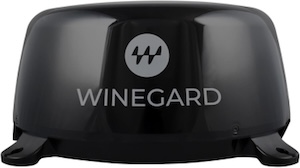
The Winegard ConnecT 2.0 stands out as one of the most recognized RV WiFi systems on the market. It mounts directly to your RV roof and pulls in distant WiFi signals before redistributing them throughout your rig. Its design focuses on long-range performance and reliability in crowded campground environments. Many RVers choose this system because it integrates seamlessly into their setup and provides consistent connectivity across multiple devices.
Pros:
- Strong long-range WiFi performance
- Designed specifically for RV roof mounting
- Supports multiple connected devices
Cons:
- Installation requires drilling and setup
- Higher cost than portable options
2. KING WiFiMax Pro Router Range Extender
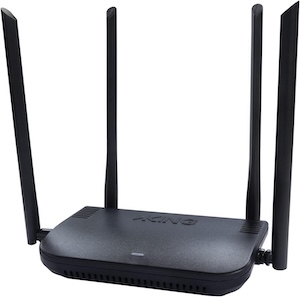
The KING WiFiMax Pro offers a simple, portable solution for RV travelers who want better WiFi without complicated installation. It connects to existing networks and redistributes the signal inside your RV. Setup takes only minutes, making it ideal for weekend travelers or those who frequently move between locations.
Pros:
- Easy plug-and-play setup
- Compact and portable
- No permanent installation required
Cons:
- Limited range compared to roof-mounted systems
- Performance depends heavily on available signal
3. C. Crane CC Vector RV WiFi Repeater System
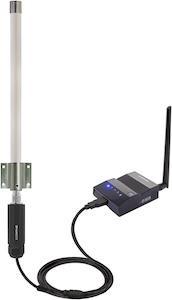
The C. Crane CC Vector system focuses on long-range signal capture with an outdoor antenna designed to reach distant WiFi sources. It excels in environments where signals exist but remain weak, such as large campgrounds or rural areas near public hotspots. Its directional antenna helps maximize performance when properly aligned.
Pros:
- Excellent long-range capability
- Outdoor antenna improves signal capture
- Reliable in weak-signal environments
Cons:
- Requires manual setup and aiming
- Bulkier than compact alternatives
4. weBoost Drive Reach RV Cell Signal Booster
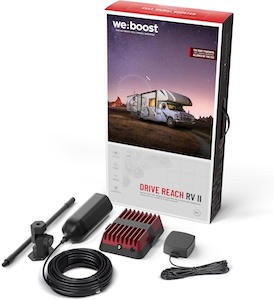
While technically a cellular booster, the weBoost Drive Reach RV plays a critical role in RV connectivity. It amplifies cell signals from nearby towers, allowing you to create a strong mobile hotspot. This option works especially well when campground WiFi fails or doesn’t exist at all.
Pros:
- Improves cell signal for hotspot use
- Works across multiple carriers
- Ideal for remote locations
Cons:
- Requires a cellular data plan
- Does not boost WiFi directly
5. weBoost Destination RV Cell Signal Booster
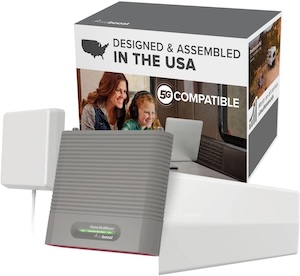
The weBoost Destination RV system provides a powerful stationary solution for long-term stays. It uses a telescoping pole and directional antenna to capture distant cell signals and distribute them throughout your RV. This setup works best for travelers who stay in one place for extended periods and need maximum performance.
Pros:
- Exceptional signal boosting power
- Great for stationary setups
- Supports multiple users and devices
Cons:
- Not designed for use while driving
- Larger and more complex setup
WiFi vs. Cellular Boosters: Which One Do You Need?
Many RV travelers start with a WiFi booster and quickly realize they need more flexibility. Campground WiFi often becomes unreliable during peak hours, even with a booster.
That’s why experienced RVers frequently rely on cellular data as their primary internet source. A cellular booster strengthens your connection to nearby towers, while your phone or hotspot provides internet access.
If you travel frequently and visit remote areas, a hybrid approach works best. Use a WiFi booster when campground networks perform well, and switch to cellular when they don’t.
Tips for Getting the Best Signal on the Road
Even the best equipment performs better when used correctly. Placement matters. Always position external antennas as high as possible and free from obstructions.
You should also minimize interference inside your RV. Keep routers away from metal surfaces and electronics that may disrupt signals.
Timing plays a role as well. Campground WiFi often slows down in the evening when everyone logs on. Switching to cellular during peak hours can dramatically improve your experience.
Finally, always test multiple networks when available. Sometimes a nearby business or public hotspot provides a stronger signal than the one at your campground.
Is an RV WiFi Booster Worth It?
For most RV travelers, the answer is yes.
A WiFi booster turns unreliable campground internet into something usable. It extends your range, improves your connection, and reduces frustration. When paired with a cellular booster, it creates a complete connectivity solution that works almost anywhere.
If you rely on internet access for work, navigation, or entertainment, a booster quickly becomes one of the most valuable upgrades you can make to your RV.
Final Thoughts
RV travel gives you the freedom to explore without limits, but staying connected ensures you can work, plan, and share your journey along the way. A quality RV WiFi booster bridges the gap between adventure and connectivity, allowing you to enjoy both without compromise.
As you choose your setup, think about how you travel, where you camp, and how important internet access is to your lifestyle. Whether you go with a simple extender or a full-scale roof-mounted system, the right booster will make every mile more enjoyable.
